The D.El.Ed. programme in West Bengal is designed to develop the teaching skills and professional competencies of aspiring and newly entering primary school teachers.
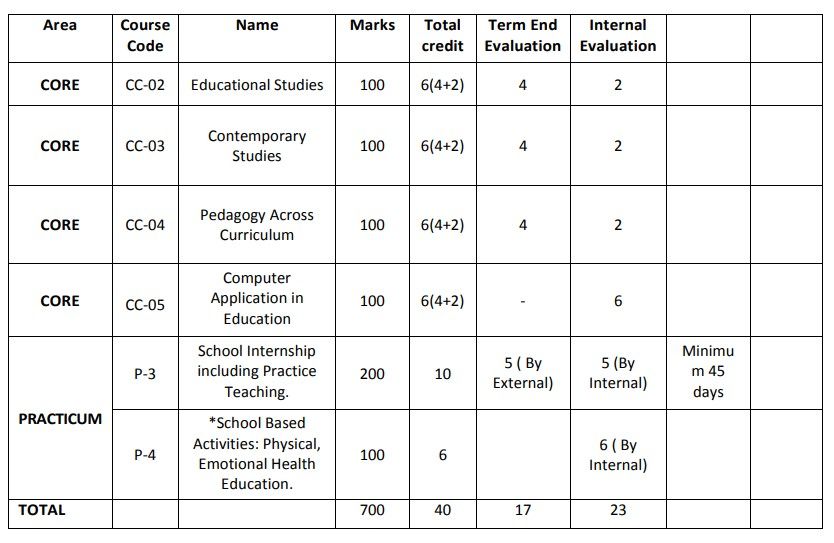
Course Structure: Part-2 (First Year)
Total Marks : 700 (External :310 ; Internal :390) Total Hours : Theory-270hrs; Practical-330 hrs
(CC-02 SYLLABUS): EDUCATIONAL STUDIES
Maximum Marks = 100
Internal = 30 & External = 70
Pass Marks = 40% of Full Marks in each of the External & Internal Evaluation
Contact = 90 hours
- To understand and explore the meaning, aims and purposes of education
- To develop understanding of philosophical, sociological and historical dimensions of education
- To identify and question one’s own long-established presumptions on knowledge, learner, teacher, and education, and develop a more informed, meaningful understanding of them
- To expose students to divergent educational thoughts, perspectives and practices, which will help them in creating secure, egalitarian and pedagogically sound learning situations
Unit-1 : Philosophical understanding of Education [Class: 7 hours]
- Understanding the basic assumptions about Human nature, Society, Learning and aims of Education
- Relationship between Schooling and Education and exploring various educative process in Human Societies
Unit-2 : Factors of Education [Class: 8 hours]
- Factors of Education – Teacher, Learner, Curriculum, School
- Child centric education and its importance
- Learners in context: situating learner in the Socio-political and cultural context
Unit-3 : Learning, Learner and Teaching [Class: 7 hours]
- Learning – Concept and nature
- Learning – Knowledge and skills
- Different ways of learning
- Meaning of teaching and its relationship with learning and learner
Unit-4 : Knowledge and Curriculum [Class: 8 hours]
- Child’s construction of knowledge: attaining knowledge through activity and experience
- Definition of Curriculum and types of Curriculum
- Factors of curriculum
- Purposes of Education, Needs and abilities of Education
Unit-5 : Great Educators [Class: 11 hours]
- Indian Thinkers – Gandhi, Aurobindo, Tagore, Vidyasagar, Vivekananda
- Western Thinkers – Rousseau, Dewey, Froebel, Montessori, Piaget
Unit-6 : Education Politics and Society [Class: 10 hours]
- Political nature of Education
- Role of Education in reproducing dominance and challenging marginalization with reference to Class, Caste, Gender and Religion
- Teacher and Society: A critical appraisal of teacher’s status
Unit-7 : Structure and process of Indian Education system [Class: 10 hours]
- Types of schools within different Administration Bodies
- Roles and responsibilities of Educational Functionaries
- Relationships between support organization and the School
- What is School Culture, Organization, Leadership and Management? What is the role of School Activities such as Assemblies, Annual Days etc. in the creation of School culture
Unit-8 : School Effectiveness and School Standards [Class: 10 hours]
- What is School effectiveness and how it is measured?
- Understanding and developing standards in Education
- Classroom management and the Teacher
- Lesson plans, Preparation for transaction and inclusive education
- Communication in the classroom and multiple learning levels in the classroom
Unit-9 : School Leadership and Management [Class: 9 hours]
- Administrative Leadership
- Team Leadership
- Pedagogical Leadership
- Leadership for change
- Change Management
Unit-10 : Change facilitation in Education [Class: 10 hours]
- Sarva Shiksha Abhiyan (SSA) experiences
- Equity in Education
- Incentives and schemes for Girl Children
- Issues in Educational and School reform
- Preparing for and facilitating change in Education
(CC-04 Syllabus) : PEDAGOGY ACROSS CURRICULUM
Maximum Marks = 100
Internal = 30 & External = 70
Pass Marks = 40% of Full Marks in each of the External & Internal Evaluation
Student Contact = 90 hours
Unit-1 : Pedagogic Practice and Process of Learning [Class: 6 hours]
- Concept of Pedagogy and Pedagogy across Curriculum— meaning, features, objectives
- Critical understanding of the process of concept-formation
- Constructivist approach in pedagogy across curriculum
- Aspects of child-centric education and creation of non-intimidating environment for knowledge construction
Unit-2 : Historical and Philosophical Perspectives of Pedagogy across Curriculum [Class: 5 hours]
- Philosophical bases of pedagogy across curriculum
- History of the development of pedagogy across curriculum
- Constructivist approach and pedagogy across curriculum
- Development of skills through pedagogy across curriculum— nature, principles, significance
- Pedagogy across curriculum for inclusive education
Unit-3 : Integrative Teaching in Pedagogy across Curriculum [Class: 5 hours]
- Concept of Integrated teaching-learning
- Concept of interdisciplinary approach— difference with multi-disciplinary approach
- Significance of interdisciplinary approach in integrated teaching at the elementary level
- Socio-cultural aspects in pedagogy across curriculum
Unit-4 : Knowledge and Methods of Enquiry [Class: 5 hours]
- Concept of knowledge, information and their differences
- Concept of Knowledge Construction—case examples from elementary school subjects
- Methods of Enquiry, different types of thinking—scientific, mathematical, social, higher order thinking
- Relation between knowledge, curriculum, text books, learners and pedagogy
- Basic tenets of enquiry based learning, contextualization, project based learning
Unit-5 : Learner and their Context [Class: 6 hours]
- Alternative frameworks of children’s thinking
- Everyday concepts and situated cognition
- Pedagogy across curriculum for contextualization—language, social relations, identity, equity, rights and their relation through education
- Eradication of Child and adult misconceptions
Unit-6 : Use of ICT for Pedagogy across Curriculum [Class: 10 hours]
- Role of ICT in education
- Use of ICT for pedagogy across curriculum
- Capacity development in the use of ICT for integrated teaching
- Significance of ICT in catering to diverse needs of children with special needs in an inclusive classroom
Unit-7 : Integration of Values and Performing Arts through Pedagogy across Curriculum [Class:10 hours]
- Value education—importance at elementary stage, integration through pedagogy across curriculum
- Types of performing arts, their relevance in education at elementary level
- Integration of performing arts—principles, significance, strategies
- Integration of performing arts for learner motivation with special reference to inclusive setting
Unit-8 : Pedagogy across Curriculum for Class I-V [Class: 15 hours]
- Content analysis for teaching in Interdisciplinary approach
- Plan and Design of relevant teaching learning material for pedagogy across curriculum—Year Plan, Unit Plan, Lesson Plan, Writing Instructional Objectives, Instructional Aids, Instructional Strategies
- Concept mapping and integrative teaching for inclusive classroom
Unit-9 : Pedagogy across Curriculum for Class VI-VIII [Class: 15 hours]
- Content analysis for teaching in Interdisciplinary approach
- Plan and Design of relevant teaching learning material for pedagogy across curriculum—Year Plan, Unit Plan, Lesson Plan, Writing Instructional Objectives, Instructional Aids, Instructional Strategies
- Concept mapping and integrative teaching for inclusive classroom
Unit-10 : Evaluation [Class: 15 hours]
- Monitoring the progress during and after lesson
- Follow-up activities—Maintenance of student profile, reporting progress
- Diagnosis and diagnostic tests in L-1, L-2, Mathematics and Environmental Science
- Remedial Measures
TET